

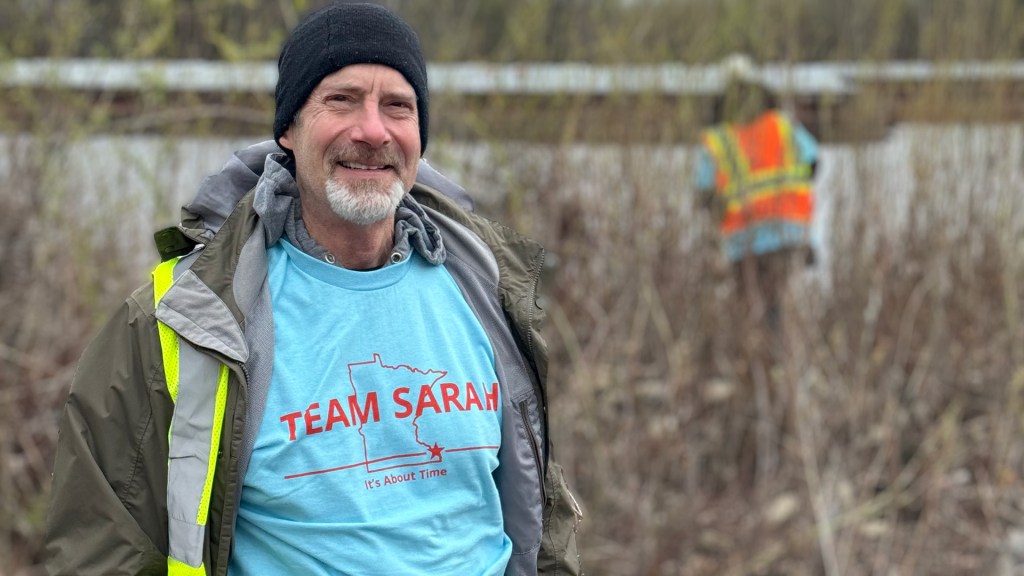
We sat down with Darrell Downs, campaign manager for the Sarah Kruger campaign, to discuss the 2024 House District 26A election.
We wanted to know his thoughts on why the DFL lost to Republicans a seat that had been blue for 38 years and what we might learn from this defeat.
The first thing Darrell pointed out was that House redistricting in 2022 has brought more Republican voters to 26A. According to Darrell, “In 2020, prior to redistricting, our House district did not include Goodview, and the total was 15,803. In 2022, after redistricting added Goodview, we were up to 17,179 voters.” Because Goodview tilts more red than Winona, and Trump was at the top of the ticket, voters turned out in high numbers. “In 2024, the vote total was up to 23,208,” Darrell said. Trump also drove high GOP turnout in the countryside, Darrell added: “A significantly larger and Republican leaning electorate turned out from areas like Lewiston; high turnout in rural townships was not expected.”
A second factor was a bruising primary race that divided the local DFL. When Representative Pelowski announced unexpectedly that he would not seek reelection, two popular candidates jumped into the race, both of whom had plenty of supporters. “Sarah’s campaign began in January 2024,” Darrell said. “Soon after, Dwayne Voegeli announced his candidacy, and it was clear that we would have a contested DFL endorsement in March.”
Because Pelowski had held 26A for 38 years, many local DFLers were not well acquainted with the caucus process for House candidate selection. In the Minnesota caucus system, attendees gather by precinct to elect delegates who go on to elect their House candidate during a convention organized at the Senate District level. The candidate who wins nomination must then be elected by DFL voters at large in Minnesota’s August primary election.
On caucus night, February 27th, unexpectedly high numbers of attendees showed up in support of their candidate. Some thought they would be electing their candidate by popular acclaim. Some were surprised to find out that each precinct has a set number of delegates, determined by past voting turnout numbers—meaning not everyone would be going to the district convention. To add to the confusion, some party members who were upset by the level of conflict the contest was kicking up hoped the August primary would sort out the problem, which, Darrell said, “in my view was detrimental to either candidate coming out of the convention with strong party backing.”
The nominating convention in March was an exhausting affair, running late into the afternoon. Although Sarah Kruger held a majority throughout, and her numbers went up as each vote was held, she could not get over the vote threshold to win the day. “With Sarah winning the majority at the convention but not by the requisite 60 percent,” Darrell said, “the convention ended without an endorsement, and both candidates plunged into a divisive and expensive five-month race toward the August primary.”
Sarah Kruger eventually won the primary and outperformed Dwayne Voegeli in the core of Winona and most of the rural townships, but, said Darrell, “It came at a heavy price.” Sarah’s campaign now had barely two and a half months to mount an appeal to general voters. “Due to the primary race and state spending caps, her campaign had little ability to spend more on ads and mailers,” Darrell said, whereas the Republicans had seemingly unlimited money for the same. What was worse, the primary fight had given Republicans plenty of material to use against Sarah.
The Kruger campaign waged a valiant fight, putting in long hours walking the precincts and rural Winona. “The campaign prioritized a less costly but more labor-intensive ground game (with 24,000 doors knocked by November) and used targeted social media,” Darrell said. The campaign had tremendous support from the DFL Combined Campaign and from numerous outside groups that had endorsed Sarah. But it wasn’t enough to turn the tide.
“On election day, we fell short of a win by 1,325 votes,” Darrell said: “In 26A, Repinski outperformed all Republicans (including Trump) and all Democrats (including Harris) in 26A.” Most disconcertingly, some split-ticket voting cut into the Kruger vote. “It is clear that 626 Harris voters chose not to support Sarah,” Darrell said. “This may have been the result of Never-Trumper Republicans choosing Harris and then down ballot voting for Repinski…on the other hand, Amy Klobuchar and Rachel Bohman both slightly outperformed Kruger in 26A, which suggests something else was going on. This may have been a lingering result of dissatisfied Voegeli supporters, pro-life DFL voters, the impact of attack ads, or any combination thereof, we will never know for certain.”
So what can we learn from this?
“We harmed our own chances by not working harder to produce a single endorsed candidate at the March convention,” concludes Darrell. The Minnesota caucus system might seem arcane, but it is the system we have–and the August primary comes far too late in the election cycle.
A second lesson is that in a much more Republican-friendly environment, Winona County DFLers will have to be thoroughly prepared and absolutely united if we want to win back House District 26A.


 Winona County Democratic Farmer Labor Party