

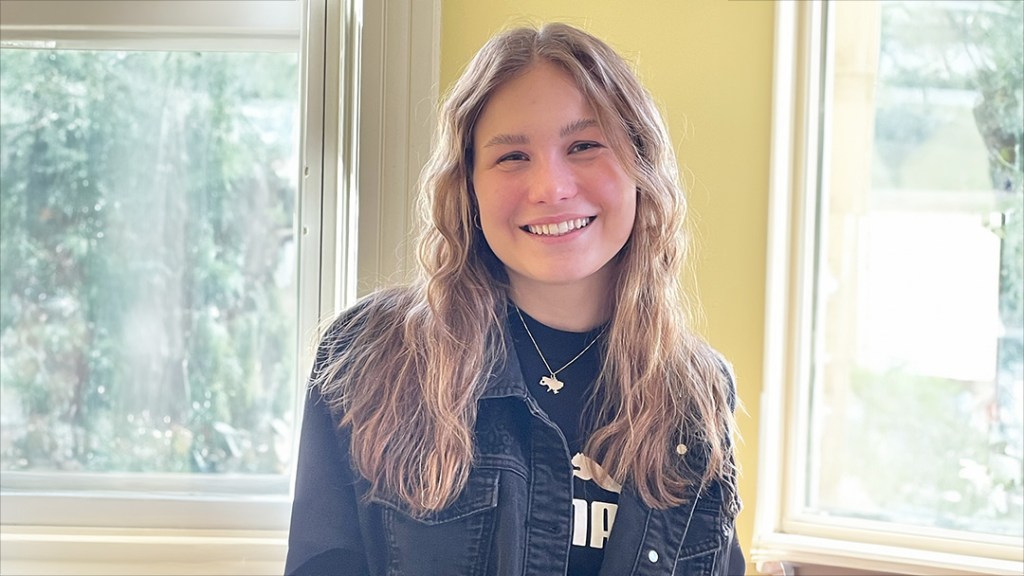
Viktoriia Kuchma was a foreign exchange student in Chippewa Falls, Wisconsin, when Russian forces invaded her home country, Ukraine. She had come to the U.S. to improve her English and to experience American culture; overnight, everything changed.
Viktoriia (she goes by Vika) is a native of Lviv, the cultural and economic capital of Western Ukraine. She came to Chippewa Falls as a high school junior, as part of a cultural exchange program that sends young people from Eastern and Central Europe to the American Midwest. She was halfway through her junior year, enjoying getting to know American students and participating in school and community events, when suddenly she was watching news footage of Russian tanks and exploding missiles as Ukraine endured the largest attack on a European nation since World War II. By June, Russian troops occupied some 20% of Ukrainian territory, and eight million Ukrainians had been internally displaced. Going home to Lviv did not seem safe. When Vika’s host family offered to let her stay with them another year, she and her parents agreed. “I decided to finish high school in Wisconsin, and then I decided to go to college here,” she says. She is now a freshman at Winona State, living with a new host family.
Vika says she feels lucky to be in Winona, where there are “a lot of immigrants and international students” who can understand her predicament. There is even one person in Winona who is from Lviv, so Vika gets to talk in her native language from time to time. “I feel welcome here,” she says.
Nonetheless, it is hard to be here when a war is on. Vika facetimes her family once a week and messages them at least once a day. It is hard to be so far away from them. Lviv is distant from the front lines, but it has suffered from missile barrages. Many of the important monuments in town have been covered to protect them from harm. The universities have been damaged, and even a kindergarten was hit. Sometimes her parents have to go to air raid shelters. Vika worries that Americans may be losing interest in the war: “It is important to raise awareness; so many people forget it is happening. I don’t hear people talking about it anymore; some of them even ask me if the war is still going on.” Vika stresses, “People should know that it is not getting any easier, it is not calming down.” She also mentions, “Many times soldiers have to use their own money or hold fundraisers for tanks, cars, drones. Even good food.” She has an uncle in the army, and the family sends him homemade food because the soldiers get very little food or bad food. She says it is important for people to keep engaged.
“Ukraine is like a shield of Europe,” she says. “If we weren’t standing up, the war would spread.”
What gives her hope? “Watching how many countries are on our side, giving physical, material support,” she says.
If Winonans want to help, she recommends contacting https://www.uscis.gov/ukraine, which allows Americans to sponsor Ukrainian citizens who are outside the United States to come here and stay temporarily for a 2-year period.
Another action people can take is to contact their representatives. Polls show the majority of Americans want to support Ukraine, and even some Republicans are willing to send aid, but aid is currently being held up in the U.S. House of Representatives by a small number of conservatives who don’t sympathize with Ukraine. The House is coming back into session this week, and support for Ukraine is supposed to be on the docket. Please call Representative Brad Finstad today and encourage him to support military funding for Ukraine: https://finstad.house.gov/contact.


 Winona County Democratic Farmer Labor Party